Getting The L1 copyright Work
Table of ContentsL1 copyright Can Be Fun For EveryoneL1 copyright Fundamentals ExplainedWhat Does L1 copyright Do?5 Simple Techniques For L1 copyright5 Simple Techniques For L1 copyright
L-1 visas are available to employees of a global company with workplaces in both the USA and abroad. L1 copyright. The copyright permits such foreign employees to transfer to the company's US office after having actually worked abroad for the firm for at the very least one continual year within the previous three prior to admission in the United StatesOne L-1 copyright can allow multiple employees entrance into the United States.
In 2019, Indian nationals received 18,354 L-1 visas, accounting for 23.8% of all L-1 visas issued in 2019. According to USCIS information, the biggest employers to get L-1 visas in 2019 were Tata Working as a consultant with 1,542 accepted L-1 copyright requests, Infosys with 517, Amazon with 455, Observant with 382, and Deloitte with 305.
Congress created the L-1 copyright in 1970. The original copyright called for that the work tenure correspond straight prior to using for the company transfer.
The 15-Second Trick For L1 copyright
Significant Indian outsourcing companies such as Tata, Infosys, and Wipro progressively used the L-1 copyright team American international companies. Fifty percent of Tata's workers gave the United States began L-1 visas. The North American Open Market Agreement had stipulations relating to intracompany transfers between the united state, Canada, and Mexico.
In 2003, the Us senate Judiciary Committee held a hearing on the L-1 copyright. In financial year 2004, the number of L-1B visas exceeded the number of L-1A visas.
Candidates that remain in the USA at the time of the declaring of the I-129 can ask for a change of standing from their existing nonimmigrant standing (i.e. visitor, student, etc), as long as they remain in standing at the time of the filing of the I-129. If they head out of status after the declaring, however prior to authorization, there is no negative repercussion, and the person does not accrue unlawful presence.
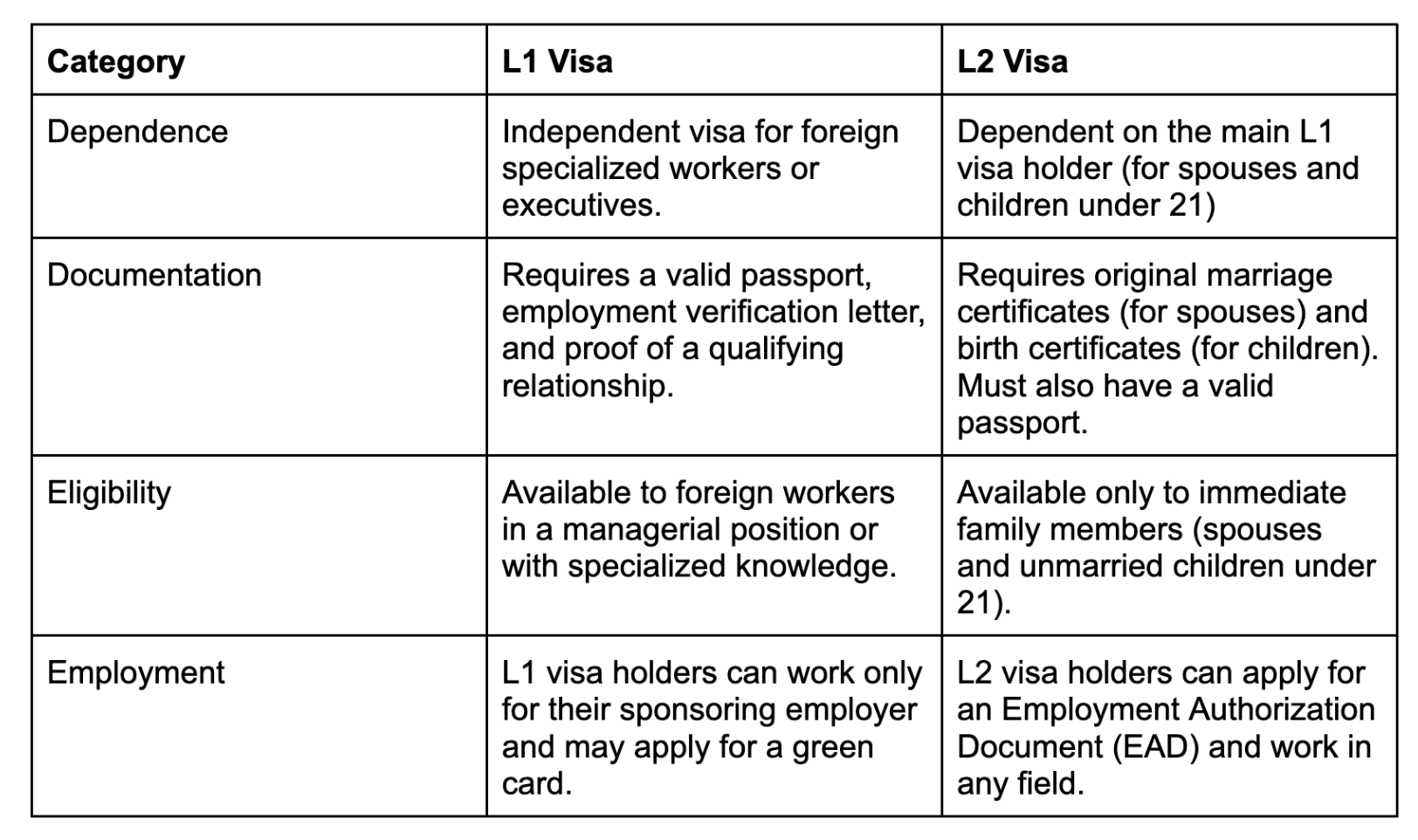
Youngsters of the primary L-1 can attend institution. The spouse of the key read more L-1 has an automatic right to operate in the United States. Children can decline paid work. The partner can, but need not, apply with the USCIS for work consent after showing up get started in the United States and, after issuance of the Employment Consent Paper (EAD, Kind I-765), may after that benefit any kind of employer.
How L1 copyright can Save You Time, Stress, and Money.
An I-797 Notification of Activity showing the approval of the copyright does not ensure that a copyright will be released at the United state
The Single Strategy To Use For L1 copyright
For an L-1 copyright candidate, "twin Intent" is enabled: unlike some classes of non-immigrant visas (e.g., J-1 visas (L1 copyright)), L-1 applicants may not be rejected a copyright on the basis that they are an intending immigrant to the USA, or that they do not have a residence abroad which they do not intend L1 copyright law firm to abandon
Revival in the United States uses to standing only, not the real copyright in the key. copyright revival, the candidate has to go to an U.S
An alien can not leave the United States and then reenter without a valid L-1 copyright, and must show up directly prior to a consular policeman copyright issuance.
Facts About L1 copyright Uncovered
An individual in L-1 standing usually might work only for the petitioning company. If the L-1 worker gets in based on an L-1 covering, nonetheless, it generally is feasible for the worker to be relocated the very same capability to any type of various other associated firm provided on the covering. The L-1 copyright program has been criticized for numerous factors.
In one example, The united state Division of Labor fined Electronic devices for Imaging $3,500 for paying its L-1 copyright workers $1.21 an hour and working several of them as much as 122 hours a week. Some industry representatives have actually accused companies of making use of the L-1 program to change united state employees. Critics and government authorities have actually pointed out how the copyright program does not define "specialized knowledge" for foreign workers in the L-1B copyright classification.
Comments on “L1 copyright Explained”